


Trekking operators and travelers are being advised to prepare for higher costs when climbing Mount Rinjani starting next year, following changes in permit fees and labor costs.
Rinjani trekking packages are expected to see price increases in 2026 due to higher entrance permit fees and anticipated salary adjustments for licensed guides and porters. The permit fee increase has already taken effect since November, while official announcements regarding guide and porter wage increases are expected in early 2026.
The changes have sparked widespread concern and protest among trekking organizers (TOs), many of whom argue that the higher costs will impact competitiveness and affordability for both domestic and international hikers. However, authorities have confirmed that the permit increase is part of a broader policy decision by the Ministry of Forestry.
According to the Ministry, Mount Rinjani—specifically the Senaru, Sembalun, and Torean routes and surrounding areas—has been officially upgraded from Class 2 to Class 1. This reclassification reflects the mountain’s increasing popularity, ecological importance, and the need for higher standards of management, conservation, safety, and visitor services.
As a Class 1 conservation area, Mount Rinjani will require greater investment in environmental protection, infrastructure, and human resources, which has directly influenced the rise in permit fees and operational costs.
Trekking operators note that while the increases are unavoidable, they aim to maintain service quality, fair wages for local guides and porters, and sustainable tourism practices on the mountain. Travelers planning to climb Mount Rinjani in 2025 are encouraged to book early, while those planning trips in 2026 should expect revised package prices reflecting the new regulations.
Despite the higher costs, stakeholders emphasize that the long-term goal is to preserve Mount Rinjani’s natural environment while improving safety, professionalism, and overall trekking experiences.
Source: HaLoMi Trekker

A common question is how to go to Mount Rinjani. There are only two main roads in Lombok: one leads up the west side of the island to Senaru, while the other leads up the east side to Sembalun. If you are already on the island, visiting Mount Rinjani is fairly easy. To get to the starting point of the journey, several trekking companies provide transportation. You should budget extra if you are traveling from the airports in Kuta Lombok or Lombok Praya.
You can drive yourself to Senaru or Sembalun if you've rented a scooter, but be mindful because driving laws and regulations in Lombok are less strict than compared to those in other parts of the world. Take a public boat or a speedboat that is privately chartered from the Gili Isles to Bangsal Harbour. From there, you can arrange for a driver to transport you to Senaru, or we can pick you up. On Lombok, public transportation is sporadic and unreliable. Instead of using minibuses, Rinjani Trekking Guide picks up its clients and drives them to Senaru or Sembalun. These have seat belts and air conditioning, so they're comfortable.
Travel times on Lombok Island:
- Bangsal Harbour to Senaru: 1.5 hours
- Sengiggi to Senaru: 2 hours
- Mataram to Senaru: 2.5 hours
- Lombok Praya International Airport to Senaru: 3 hours
- Kuta Lombok to Senaru: 3.5 hours
Source: Rinjani Trekking Guide
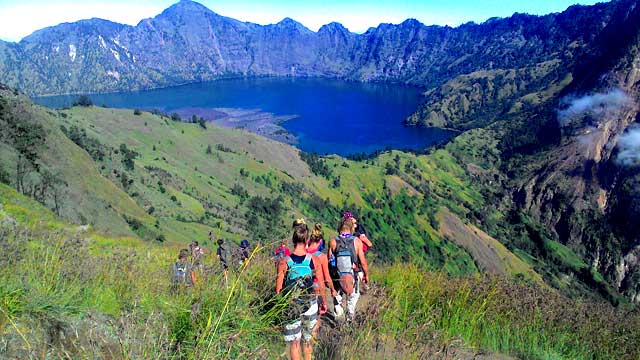
Travel agent or trek organizer who offering Rinjani Trekking Packages is very easy to find on the internet, because now each of them had a website for offering their packages to their client candidates with online reservation, but to get an agency who are sell their packages in cheap and reliable with the good services is not easy to find.
Climbing Mount Rinjani with an agency or Tour Operator is one of the solution for who are not want to bother but very interest to visit and enjoying the atmospher of Mount Rinjani with safe, fun as well with the good services and cheaper!
You can check the following list below of several agency based in Senaru that we know quite well and sell their packages to Mount Rinjani with cheap, good services and was include the pick up services a day before the hike, one night hotel in Senaru, all gears as well as to drop you to your next destination after the hike:
For you who will climb Mount Rinjani via Senaru route or Sembalun Route (It's only 2 official routes that most safe, most used and popular to climb):
Update on 2024 - cheap and reliable tour operator:
- Rinjani Group Trekking: www.rinjanigrouptrekking.com
- Rinjani Trekking Guide: www.rinjanitrekkingguide.com
- Nemoe Trekker: www.nemoetrekker.com
- Go Backpacker Rinjani: www.gobackpacker.net
- Rinjani Sunrise: www.rinjanisunrise.com
- LA Rinjani: www.larinjani.com
- Team Backpacker: www.teambackpacker.com
- HaLoMi Trekker: www.halomitrekker.com
In addition there are many other agents that you can contact, if you need any further information about trekking to Mount Rinjani with cheaper from Senaru or Sembalun routes, feel free to contact us to help.lomboktrip@gmail.com. and if you know any other agents who sell their packages with good services and cheap, please share your experiences by leave and submit your comment here.
 |
| [Photo by: Halomi Trekker] |
Hiking activities on Mount Rinjani continue to escalate by an average of 20 percent per year. Hikers see the 3,768-meter tall mountain a challenge that must be conquered. Mount Rinjani is one of the best tourism destinations for nature lovers across Southeast Asia.
In 2012, 4,839 foreign tourists and 633 domestic tourists explored Mount Rinjani by traveling through the Senaru village, the main entrance to the mountain, in Lombok. Meanwhile, 4,360 foreign tourists and 4,887 domestic tourists ventured to the mountain through Sembalun village in East Lombok.
Head of the West Nusa Tenggara Culture and Tourism Department, Gita Aryadi, says Rinjani has received several awards, including the World Legacy Award from Conservation International and National Geographic Traveler (2004), two awards from the Tourism for Tomorrow Award (2005 and 2008), and the Cipta Award from the Ministry of Tourism and Creative Economy.
Source: TEMPO

The park covers an area of 41,330 ha on the northern part of Lombok. Named after Indonesia’s second highest volcanic peak outside of West Papua, the peak of Gunung Rinjani (3,726m) dominates the landscape. Within the crater is the spectacular Segara Anak lake and the still-active volcano Gunung Baru (2,363m). It is surrounded by a further 66,000 ha of Protection Forest and covers the four administrative district of West, East, north and Central Lombok. The park ecosystem is in the transitional zone between Asia and Australia (Wallace zone). Average rainfall is about 3,000 mm annually. Gunung Rinjani is rich in a variety of flora, fauna and vegetation types. On the south western side of the mountain is the most eastern extent of primary rainforest in Nusa Tenggara. This gives way to monsoon forest and drier climate in the east, and savannah in the north east. Notable flora includes the everlasting edelweiss flower (Anopheles viscid), tiger orchid (Vanda sp.), alang-alang grass (Imperata cylindrical), cemara trees (Casuarinas trifoliate and Casuarinas occidental).
Mt. Rinjani, one of the over 40 National Parks throughout Indonesia, was established in 1997. It is valued and protected for its spiritual as well as natural values, and is worshipped by thousands of Balinese as well as Sasak pilgrims. Hot springs near the crater lake are sought after for their healing powers. Over 20 villages surround Rinjani and there are many routes up the mountain, but the main access is from Senaru in the north and Sembalun Lawang to the east. The challenging three-day Rinjani Trek route from Senaru to the crater rim (Plawangan), down to the stunning crater lake then on to Sembalun, is considered one of the best treks in South East Asia. Those heading for the summit usually prefer to start in Sembalun.
Mt. Rinjani, one of the over 40 National Parks throughout Indonesia, was established in 1997. It is valued and protected for its spiritual as well as natural values, and is worshipped by thousands of Balinese as well as Sasak pilgrims. Hot springs near the crater lake are sought after for their healing powers. Over 20 villages surround Rinjani and there are many routes up the mountain, but the main access is from Senaru in the north and Sembalun Lawang to the east. The challenging three-day Rinjani Trek route from Senaru to the crater rim (Plawangan), down to the stunning crater lake then on to Sembalun, is considered one of the best treks in South East Asia. Those heading for the summit usually prefer to start in Sembalun.
The village of Senaru and Sembalun is the main gateway to Gunung Rinjani National Park, the most popular start point for the three day Rinjani Trek up Indonesia’s second highest volcanic peak (3,726m). For the people of Lombok, Sasak and Balinese alike, the volcano is revered as a sacred place and the abode of gods. Within the spectacular crater, the Segara Anak Lake is the destination of many pilgrims who place offerings in the water and bathe away disease in the nearby hot springs. Developed with New Zealand Government assistance since 1999, the Rinjani Trek Centre embodies under one roof (satu atap) the unique partnership of the National Park, tourism industry and local communities that has been forged to manage and protect the Rinjani mountain environment.

Volcanic activity of Mount Baru Jari, Mount Rinjani’s caldera, in Lombok, West Nusa Tenggara, is still quite high.
Visual information and seismic data from the Mount Rinjani Observation Post showed that Mount Baru Jari still sprayed white thick ash measuring 1,000 – 1,500 meters.
In the meantime, spread of thin volcanic ashes on Saturday (7/11) at 11 am Central Indonesian Time was still dominant in the southern part and the southwest of the mountain. However, the spread of ashes is smaller than that in the previous days.
Ngurah Rai in Denpasar, Bali and Banyuwangi airport are still free from the ashes.
“The potential of eruption is still quite high. Mount Rinjani is still at Level 2,’’ said Head of Information Data Center and Public Affairs of the National Disaster Mitigation Agency (BNPB) Sutopo Purwo Nugroho.
Sutopo also said that as of now, it is not necessary yet to evacuate the residents.
However, residents living near Rinjani and visitors are not allowed to do any activities within the radius of 3 kilometer from the slope of Baru Jari.
Furthermore, to anticipate the impacts of the eruption, Regional Disaster Mitigaiton Agency (BPBD) has already set up evacuation tents in nine locations.


Recent Comments